This article was originally published in Japanese in July 2019 and has been translated into English.
At Ginza Sony Park, the event “#009 WALKMAN IN THE PARK” was showcasing historical Walkmans. Celebrating the Walkman’s 40th anniversary, the event displayed models from 1979 to the present. The exhibition ran from July 1, 2019, to September 1, 2019, with related items like T-shirts available for purchase.
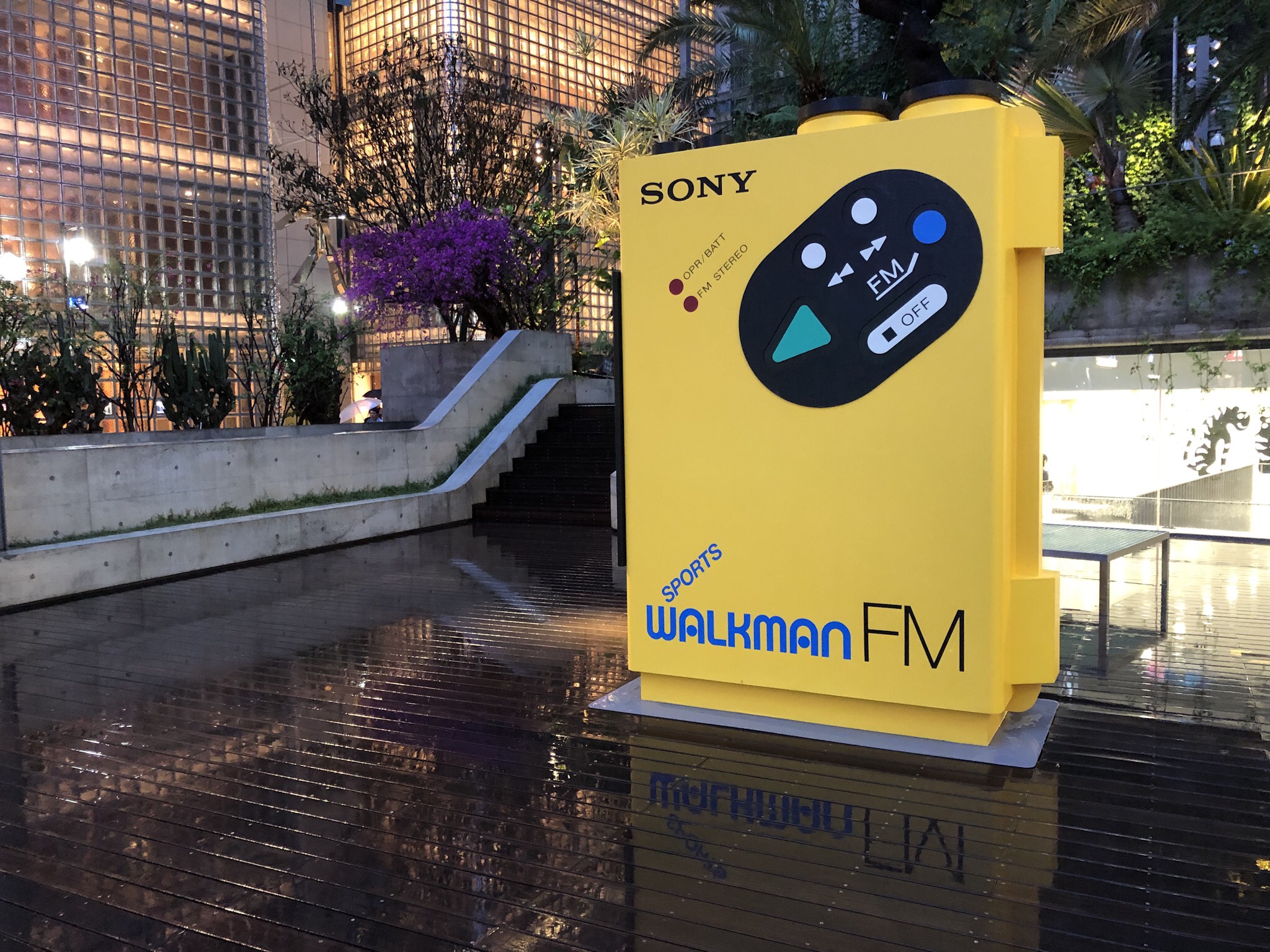
Upon arriving at Ginza Sony Park, the first thing you notice is a giant Walkman sculpture.

The sculpture is based on the “WM-F5,” a sports model Walkman.
I never owned this particular model, but this era’s medium was the cassette tape. People in their twenties and younger today may not be familiar with cassette tapes, so to explain briefly, they were magnetic tapes used for music, available in various grades. For better sound quality, albeit at a higher price, people would buy metal tapes to record music.
Recording involved transferring from one tape to another, from the radio to tape, or from a CD to tape, typically using a CD radio cassette player or mini component system. We would trade recorded tapes with friends, introducing each other to favorite songs, or compile a “best album” from various CDs—essentially a playlist in today’s terms.
Compared to digital music, the sound quality was poor. It was analog, so magnetic tapes introduced noise and degraded over time. Unlike today, where copying music takes seconds, back then, recording was done in real-time playback. Some high-end cassette decks had double-speed recording, but typically, it took as long as the album’s playback duration—60 minutes of music meant 60 minutes to record.
Then came the MD (MiniDisc), which replaced cassettes. MDs, being optical discs, were more resistant to degradation and allowed for instant access to any track, unlike cassettes, which required rewinding or fast-forwarding to find specific songs. Some high-end audio systems could detect silent sections to skip to the next track, but this didn’t work if there was silence within a song.
With MD, it became possible to directly access each track. Although CDs had the same functionality, the MD allowed users to record and customize playlists, taking song-sharing and playlist creation to the next level.
Later, the Walkman evolved to transfer music directly from a computer. With the introduction of Memory Stick Walkmans and Network Walkmans that stored music directly on the device, Sony took a misstep by choosing a proprietary format for music files. MP3 had become the standard format, but Sony pushed its own ATRAC3 format. Consequently, the iPod, which supported MP3, quickly overtook the Walkman. (MP3 files needed to be converted to ATRAC3 via the “OpenMG Jukebox” software.) Sony’s reluctance to involve other record companies in selling music online, as Apple did, may have been due to its roots in the recording industry.
I stopped using the Walkman around this time, turning instead to music on feature phones and then smartphones. My first smartphone was Android, where I directly transferred files, but after switching to iPhone, I managed all my music via iTunes.
Today, with an iPhone, I don’t feel motivated to buy a dedicated player just for music, but I’m glad I experienced Walkman during my youth, the time when music felt most enjoyable.
Incidentally, Sony’s MDR-EX90SL earphones were an excellent canal-type model with an open, spacious sound. I’d probably still use them if they hadn’t broken.
The only Sony product I currently use is the h.ear go (SRS-HG1) active speaker, which has since been discontinued.

Past the “WM-F5” sculpture, there’s a staircase leading down with the words “WALKMAN IN THE PARK” displayed. Descending the stairs reveals an exhibit where you can listen to music on the same Walkman models that various artists used back in the day.

On the next level down, in a café-adjacent area, a wall displays a lineup of historical Walkmans.

According to the official website, there are “about 230” Walkmans on display (why “about”? Couldn’t they count?). They span various formats—cassette tapes, MD, Memory Stick, Network, etc. Seeing them brought an instant wave of nostalgia.
Even if you didn’t own one, you likely saw them in commercials or friends’ hands.

This was the Walkman model I used the most. I was delighted to see it in the same color as mine. Sony products from that era had excellent build quality. I vividly remember using the jog dial to enter song names into the MD—click, click, click! I also had a Sony phone with the same jog dial feature.

The MD format was smaller and more convenient than cassette tapes.

My Network Walkman was the “NW-E3” model, similar to the orange one on the top left in the photo (though I remember it being red) but in silver. The red and blue versions, if I recall, were released later. The “SONY” logo was engraved, not printed. Sony’s attention to detail in materials and design was impressive.
To load music, I installed Sony’s “OpenMG Jukebox” on my computer, converted files to ATRAC3, and transferred them. The UI ignored Windows design conventions with an ornate style and customizability. It was also very heavy on memory.

The event encouraged those with rare Walkman models to post using a hashtag. I wonder if Sony doesn’t keep an archive of their models.
For anyone over 30, this event likely stirs nostalgia. For younger generations, it’s a unique chance to experience how music was played back then. I’d love to know how people accustomed to digital music perceive the sound of cassette tapes.