I wanted to photograph nemophila!
After buying a full-frame DSLR, the Nikon D750, my desire to take beautiful photos increased even more than when I had the D5200. Since I’d invested in a good camera, I wanted to capture as many stunning images as possible.
However, famous spots tend to be crowded, and getting there and back could be challenging… So I decided to join a Hato Bus tour. By booking on the Hato Bus website, I was able to secure a seat. The tour gathered at the Hato Bus stop near the Asakusa Exit at Ueno Station at 7:40 am, with departure at 8:00 am.
Since it was an early start, I got up at 4:00 am to prepare and left home by 5:00. The first train from my area wouldn’t get me there on time, so I took a bus to Haneda Airport, transferred to the monorail to Hamamatsucho, and then took the Yamanote Line to Ueno.
I arrived at Ueno Station at 7:00 am. After leaving the central gate through the Asakusa Exit, I waited at Wendy’s with a coffee and round hash browns until it was time to gather. Ten minutes before the meeting time, I headed to the bus stop, where the Hato Bus tour guide showed us to our bus.
Contrary to my expectations, it wasn’t a yellow Hato Bus; instead, we traveled with a partner bus company from the Fuji Kyuko Group.

Onboard, we received badges to identify ourselves as part of the tour, with badge colors varying by bus.

Our bus was Fuji Kyuko Tourism’s Bus #2, staffed by a Fuji Kyuko tour guide and a Hato Bus tour guide.
From Ueno, we traveled via the Tomobe Service Area to Hitachi Seaside Park. There was no traffic, so the ride was smooth.

Since it was a tour, we entered through a special group entrance. It was mostly free time, and the guide offered to lead anyone interested to Miharashi Hill, where the nemophila are located. The tour provided a lot of flexibility.

We entered the spacious park from the West Gate, also known as the “Wing Gate” for its wing-like design.

Immediately upon entering the West Gate, you see the “Water Stage,” a circular stage with a fountain behind it. Following the path by the Water Stage leads to Miharashi Hill. Nearby, there are shops and spots to take commemorative photos with nemophila-themed boards.

The park is quite large, and for an out-of-shape body like mine, all the walking was a workout.


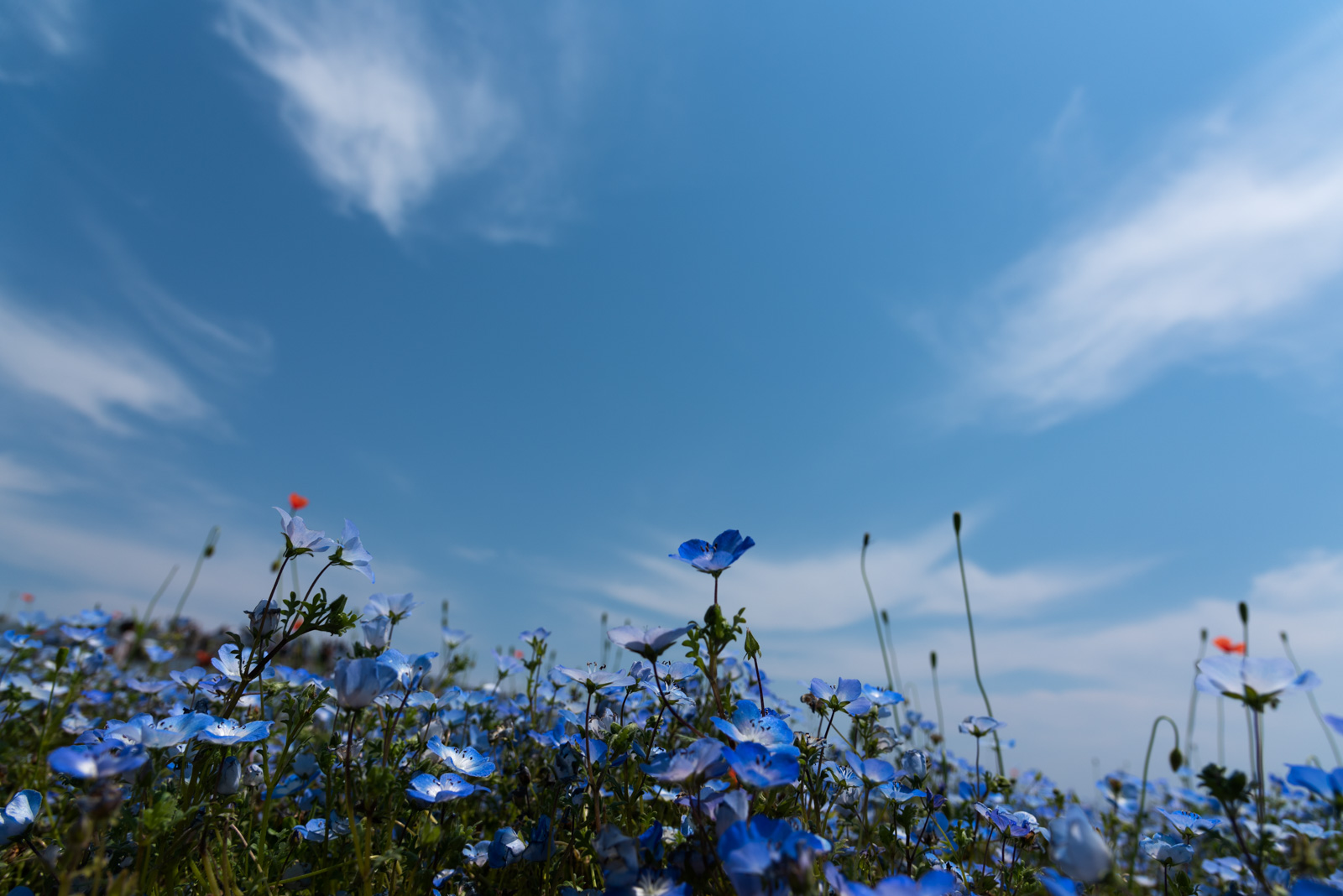
Although the peak bloom had passed, with a fair amount of greenery showing, there was still plenty of blue. The weather was good, with some clouds adding contrast to the blue sky in photos.

I captured the blue sky, nemophila’s vibrant blue, and the white clouds as an accent. Overlapping the flowers with the clouds created an effect as if something was floating upward.

I also shot a poppy flower with a soft-focus, high-key background for a light and fluffy look.

A bell is installed halfway up Miharashi Hill, but the line was long, so I skipped it.


Past the nemophila field, you can see the cranes at a nearby port, fitting for a seaside park.

Near Miharashi Hill, there was a traditional Japanese house decorated with carp streamers. It’s rare to see homes displaying carp streamers these days.

I tried the Nemophila Blue Soft-Serve Ice Cream. You can’t skip local ice cream! The blue part had a refreshing ramune (soda) flavor. It also came with a nemophila-shaped cookie, making it a great photo-op for Instagram and other social media.
Although the allotted 90 minutes felt like plenty of time, I was so absorbed in photographing that I returned to the meeting spot just in time.
It was the first Saturday after Golden Week, but I was still able to enjoy the beautiful blue nemophila fields.